Indigo Arts Gallery
Return To Indigo Arts Gallery Return To
Main Gallery

Contact/Visit Us Contact/
Visit Us

Appalachian Visionaries
Fred Carter
1911 - 1992

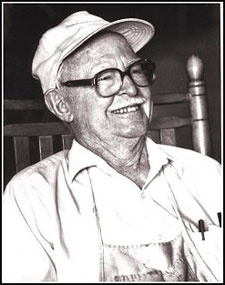
(Photograph courtesy of Gerald and Denise Gray)

Biography

Born in Duffield, VA., on the North Fork of the Clinch River, in 1911. In 1938 he moved to Clintwood, in the coal fields of far southwestern Virginia, to run his uncle's hardware store.

Fred Carter was the master of what artist, film-maker and writer Jack Wright (see reference below) has called "Appalachian Art Brut". A largely self-taught artist, Fred Carter did not turn to the wood sculpture for which he is known until he was in his fifties.

Carter was a retired Clintwood, Virginia hardware-store owner who could have rested on his laurels as a skilled and respected Appalachian wood-carver and stone-mason. Instead he chose to make trouble for himself by depicting Indians, refugees and historical figures ranging from Martin Luther King to Vladimir Ilyich Lenin in his work. Most notably, in both his sculpture and his paintings, he exposed the ravages of coal mining on both the miners and their environment: "Are you asking me how I felt when they began to tear up our mountains and rape the land and poison our streams and dry up our wells and springs?" (in conversation with writer Jack Wright in 1985, quoted in his article "Appalachian Art Brut: Reflections on the Life Works of Fred J. Carter" - Appalacahian Journal, Fall 2001). His work was his answer.


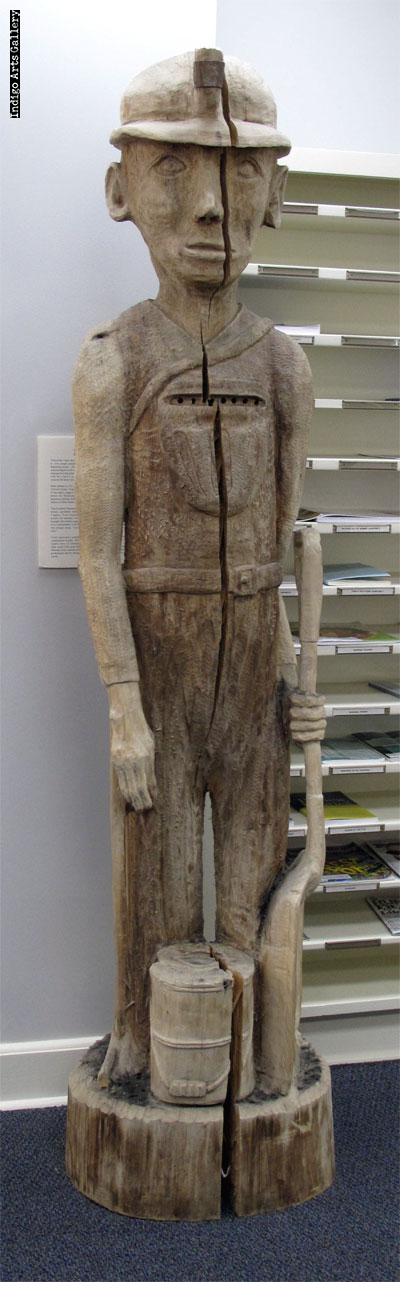
Coal Miner (detail)
Fred Carter (1911 - 1992, Clintwood, Virginia)
Currently on exhibit at Emory and Henry College, Emory, Va.
Wood sculpture

One of Fred Carter's most arresting works is his heroic larger than life-size figure of a coal miner, now installed at the Emory and Henry College library. He carries, besides his iconic helmet, lunch-pail, UMW bag and shovel, an iron lung on his chest. His ultimate work, also installed at Emory and Henry, is a janus-like figure of natural life and a mechanistic vision of death, called "The Final Battle".

Since his death in 1992 Carter has been honored by several retrospective exhibits, most notably Unrecognized Artists at the William King Regional Arts Center in Abingdon in 1997, and Fred Carter Retrospective: A Primitive Visionary's World View, curated by DR Mullins for the 1912 Gallery at Emory and Henry College., Emory, Virginia, in 2000.

The following text and photo are used courtesy of www.dickensoncounty.net, the website of Dickenson County, Virginia:

Fred Carter, 1911-1992:
Artist, Visionary, and Collector of all things Appalachia

Fred Carter was a self-taught artist who did not begin to paint and carve wood until he was fifty years old. When he died in 1992, fame had not yet come to him. Few people outside the southwest Virginia area knew his art and its haunting beauty. Slowly, this Dickenson County native is becoming acknowledged by the art world, with collections of his art being sought after for exhibits by galleries from both far and near.

Born January 6, 1911, Fred Carter was raised in the rolling farm country of Scott County, Virginia. Even before the Depression, money was scarce, and young Fred and his numerous siblings worked hard at growing and harvesting crops, as well as dozens of other chores necessary to survive on a farm in those days.

Carter moved to the Clintwood area of Dickenson County as a young man to help work in his uncle's store. He settled there and became a successfulbusinessman, builder, landscape architect, and nurseryman. By this time he had also become a collector of Appalachian artifacts. Fred Carter built the Cumberland Museum in Clintwood to house the artifacts he found and the art that he created. He said the museum housed "Primitive Things of Toil and Love". At one time the museum held the twin state's most complete collection of early Appalachian artifacts.


Cumberland Museum (now closed) - Clintwood, Va.

That boyhood "harmony with the earth" later became a driving force in his artistic expression. "You're born and your first impressions are from the earth, the people, the animals," he said. "In my carving Mountain Family, for example, the creative urge reflects where I come from. What you do, you do in remembrance of all the things that moved you, things you loved and felt strongly about. You grow intimate with all the materials you work with."

Carter possessed a remarkable personality that brought together a rare combination of gifts. Blessed with an immense energy that sparked his creative drive, he cherished the plain, the ordinary, and the radiant. He often spoke with great philosophical insight and, moreover, listened as elements in the natural world "spoke" to him. He was curious about man's predicament and his strangeness. In short, he had an ardent vision of the world.

Much of his work expressed his anger at the environmental destruction of the land and the injustices against people that society does nothing about. His paintings and sculptures range from the abstract to the realistic. Among his art works are a carved statue of a starving mountain woman and her children, a painting of the destruction caused by strip mining, and a wooden bust of a miner with black lung disease. And yet other of his works reveals the true beauty of the human spirit.

The contents of Fred Carter's beloved Cumberland Museum were sold at auction after his death, the auction taking place on May 27, 1995, with Mason and Mason Auctions of Whitesburg, Kentucky presiding. In addition to some pieces of his art, other items sold included primitive farming tools, logging and mining tools, railroad items, Spanish American and WWI Military items, an authentic moonshine still, thousands of fossils, and an actual log from the first Dickenson County Jail.

Fred Carter was truly a Dickenson County treasure, and unfortunately one who was not widely recognized as such until after his death. But through the legacy of art he left behind his life will always be remembered - and felt.

Text and photo above are used courtesy of www.dickensoncounty.net, the website of Dickenson County, Virginia.

The works by Fred Carter on this page are shown courtesy of their current owners. They are shown in the interest of honoring the legacy of this significant and currently under-appreciated artist. None of them are currently available for sale.
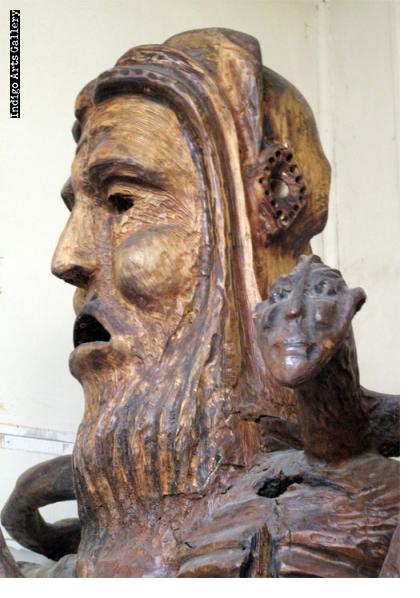


The Final Battle (detail)
Fred Carter (1911 - 1992, Clintwood, Virginia)
Currently on exhibit at Emory and Henry College, Emory, Va.
Wood sculpture, c.1990

Not for Sale (private collection)

The "Last Battle", it's the final battle between good and evil. On the one side you see the agonized face of man as he's being destroyed and on the other side you see the face of... it speaks for itself. it could be a dehumanized person or robot with a touch of the military and the evil is represented by the snake, or serpent which is devouring them both, when evil gets so far along in any society its self-destructive, it feeds on itself. And it is clear that evil is winning.
Fred Carter, from 1985 interview.


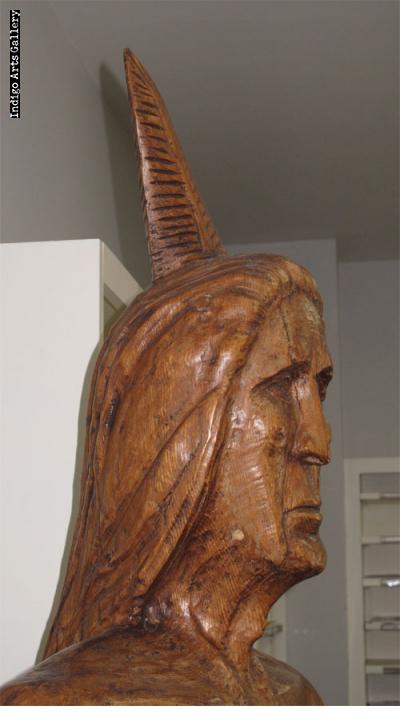
Indian (detail)
Fred Carter (1911 - 1992, Clintwood, Virginia),

Currently on exhibit at Emory and Henry College, Emory, Va.
Wood sculpture, 1978 -79

Not for Sale (private collection)


Coal Miner
Fred Carter (1911 - 1992, Clintwood, Virginia)
Currently on exhibit at Emory and Henry College, Emory, Va.
Wood sculpture, c.1990

Not for Sale (private collection)


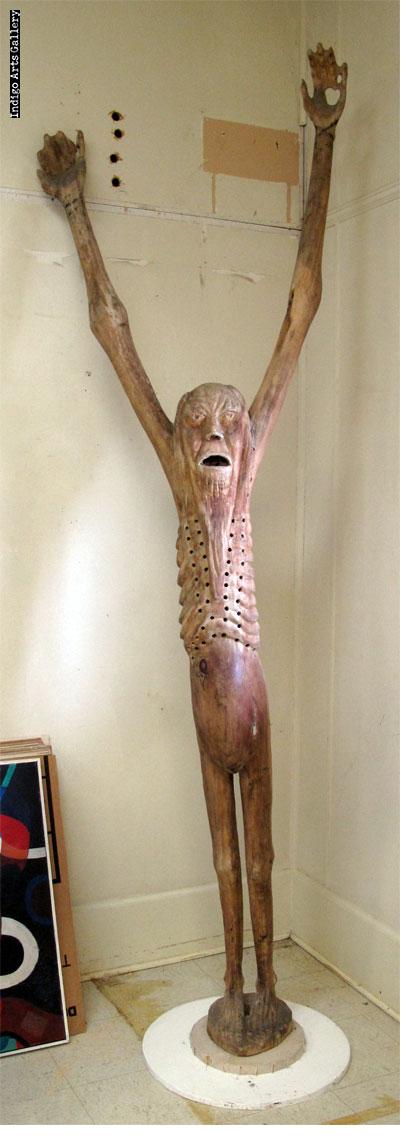
Quo Vadis
Fred Carter (1911 - 1992, Clintwood, Virginia)
Currently on exhibit at Emory and Henry College, Emory, Va.
White walnut sculpture, c.1985

Not for Sale (private collection)

Quo Vadis was a big white walnut tree. Standing and had a big fork that stuck up. Came a March wind and blew it down. I saw a thing there on the ground just all stretched out. I just looked at that tree and I saw a crucified force there. And that very day I got my chain saw and I cut it big and I drug it up to the front of there and I went to work on it. And I saw that thing just while it was down. Where goest thou? He's a mutant and he's in great trouble. It seems like everything is crying out. What is evil and wasteful is man.
Fred Carter, from 1985 interview.


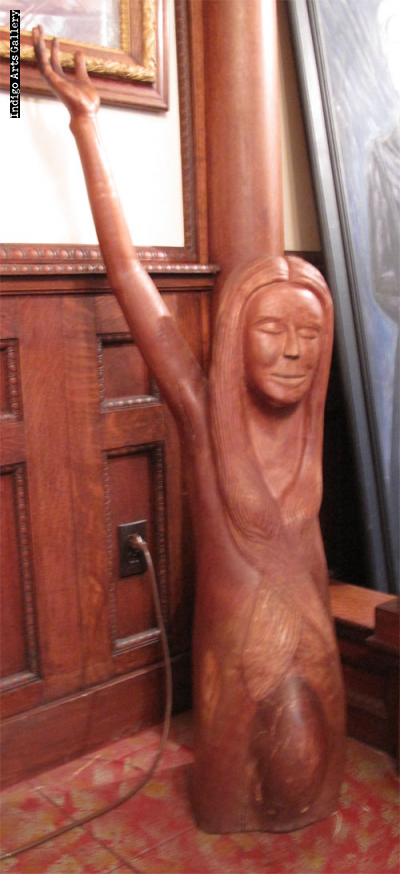
Behold my Miracle
Fred Carter (1911 - 1992, Clintwood, Virginia),
Walnut sculpture
(55" x 20"), c.1980

Not for Sale (private collection)

I was back, at Easter (1980), in the mountains, and a fellow was sawing up firewood. Now this was part of a walnut log... cut down 40 or 50 years ago... There was a limb going up through here about 10 feet long... I said, “Don’t cut that up for wood... I see something in this that I want to make... I see a pregnant woman... So I brought it home and began to look at it... the wood began to talk to me and tell me what it is...
So I will probably call this Behold My Miracle. That’s what the mother is saying,... “Behold me in the greatest moment of the miracle.

Fred Carter, from 1985 interview.


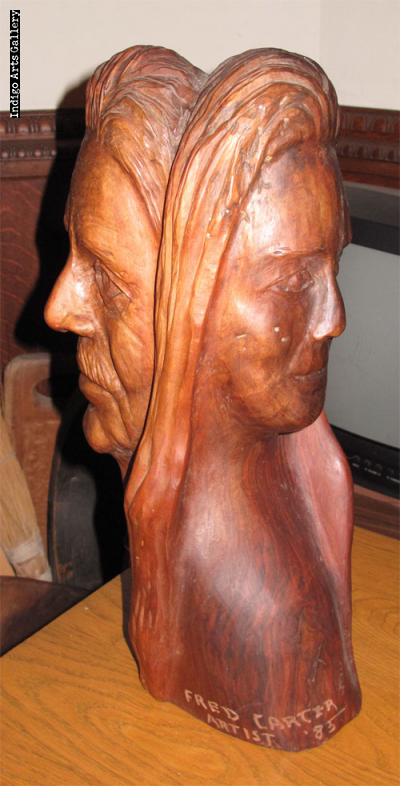
Dual Portrait (Fred and Vickie Carter)
Fred Carter (1911 - 1992, Clintwood, Virginia),
Wood sculpture
(18 1/2" x 9") 1985

Not for Sale (private collection)


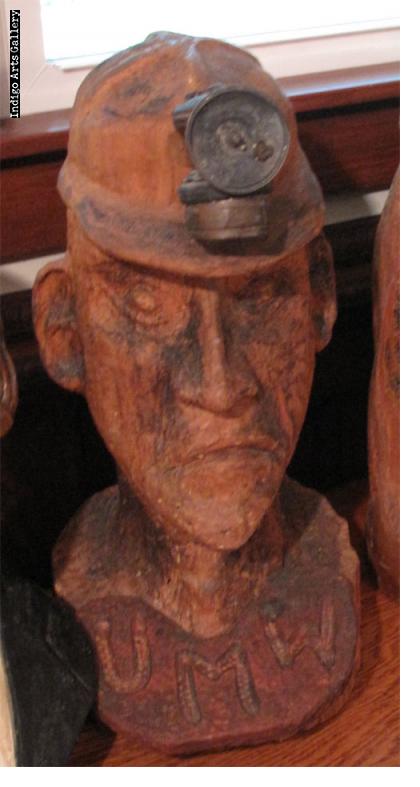
Coal Miner
Fred Carter (1911 - 1992, Clintwood, Virginia),
Wood sculpture
(20 1/2" x 9 1/2")c.1980's

Not for Sale (private collection)


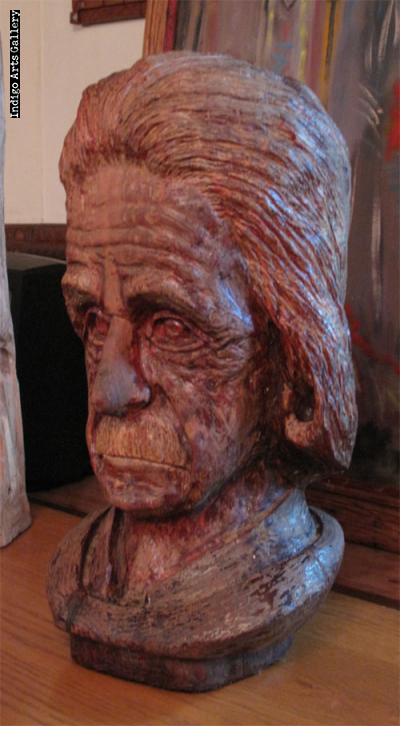
Albert Einstein
Fred Carter (1911 - 1992, Clintwood, Virginia),
Wood sculpture
(18" x 9 1/2"), 1988

Not for Sale (private collection)


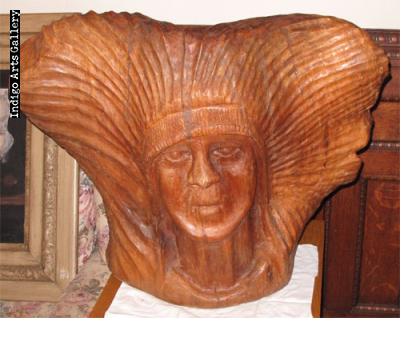
Indian Chief
Fred Carter (1911 - 1992, Clintwood, Virginia),

Wood sculpture
(24" x 30 1/2") c.1980's

Not for Sale (private collection)


Vladimir I. Lenin
Fred Carter (1911 - 1992, Clintwood, Virginia),
Wood relief sculpture
(15 1/2" x 12 1/4") c.1950

Not for Sale (private collection)

Fred was not a spiritual person in an orthodox sense. He didn’t really go to church and he was called an atheist. But he never left his church - he carried it around with him. When he was doing some of his more radical work, that got him into a lot of trouble. And because he wouldn’t espouse himself to any kind of political beliefs he was called a kind of communist. It didn’t help that he did a bust of Lenin. He swears to me that it was an estetically pleasing figure that Lenin had.
D.R. Mullins


Coal Mining
Fred Carter (1911 - 1992, Clintwood, Virginia),
Oil on board
(16" x 20"), c.1960's

Not for Sale (private collection)

Are you asking me how I felt when they began to tear up our mountains and rape the land and poison our streams and dry up our wells and springs? Aah, I won’t tell you how I felt.
Fred Carter, from 1985 interview.


Coal Sludge Pond
Fred Carter (1911 - 1992, Clintwood, Virginia),
Oil on board
(30" x 48"), c.1960's

Not for Sale (private collection)

If we continue to do nothing... we can watch the dust of desolation settle about us, as our children continue to leave, and the Big Boys Far Away begin to think of our worked out mines for places to store their deadly poisons.
Fred Carter, from 1985 interview.


The Victims
Fred Carter (1911 - 1992, Clintwood, Virginia),
Oil on board
(40" x 24"), c.1960's

Not for Sale (private collection)


Cocaine Baby
Fred Carter (1911 - 1992, Clintwood, Virginia),
Oil on board
(24" x 12"), c.1960's

Not for Sale (private collection)


Twisted Man (detail)
Fred Carter (1911 - 1992, Clintwood, Virginia),
Wood sculpture

(19 1/2" x 3 1/2"), c.1980's

Not for Sale (private collection)


Martin Luther King
Fred Carter (1911 - 1992, Clintwood, Virginia),
Wood sculpture

Not for Sale (private collection)


Mason Mooney
Fred Carter (1911 - 1992, Clintwood, Virginia),
Oil on board
(15" x 21 1/2"), c.1960's

Not for Sale (private collection)


The Last Walk
Fred Carter (1911 - 1992, Clintwood, Virginia),
Oil on board
(17" x 36"), c.1960's

Not for Sale (private collection)


Untitled face at Ghost Rocks Studio
Fred Carter (1911 - 1992, Clintwood, Virginia),
Stone sculpture

Not for Sale (private collection)


Stone Mosaic of Eagle
Fred Carter (1911 - 1992, Clintwood, Virginia),
Stone sculpture/mosaic

Not for Sale (private collection)

PREVIOUS PAGE NEXT PAGE
BACK TO APPALACHIAN GALLERY PAGE
1400 North American St., #104 • Philadelphia, PA 19122
Phone: (215) 765-1041 • Toll Free: (888) INDIART • Fax: (215) 765-1042
E-Mail: indigofamily@indigoarts.com

Al l photographs and text Copyright Indigo Arts Gallery, LLC., 1998-2012. Use without permission prohibited.

Indigo Store News And Events About Us Main Menu Indigo Arts Publications
Indigo
Store
News &
Events
About
Us
Main
Menu
Indigo Arts
Publications